

Tasting notes on a bag of beans, such as “jasmine, bergamot, and stone fruit,” can read like nonsense when every cup just tastes like coffee. They are not marketing fluff. They describe real differences that most people can learn to notice with a little structured practice. A coffee from Ethiopia can taste bright and floral, one from Colombia sweet and nutty, and one from Sumatra earthy and bold. This guide shows how to taste those differences for yourself.
Here is how you can develop yours too.
Table of Contents
What is Coffee Tasting?
First is first, let’s understand what coffee tasting means!
Coffee tasting—also known as Coffee cupping—is the sensory evaluation of brewed coffee to analyze its aromas, flavors, and structural qualities.
The Short Answer
Developing your coffee palate is about paying attention.
You do not need special skills. You do not need expensive equipment. You need to slow down, taste deliberately, and practice.
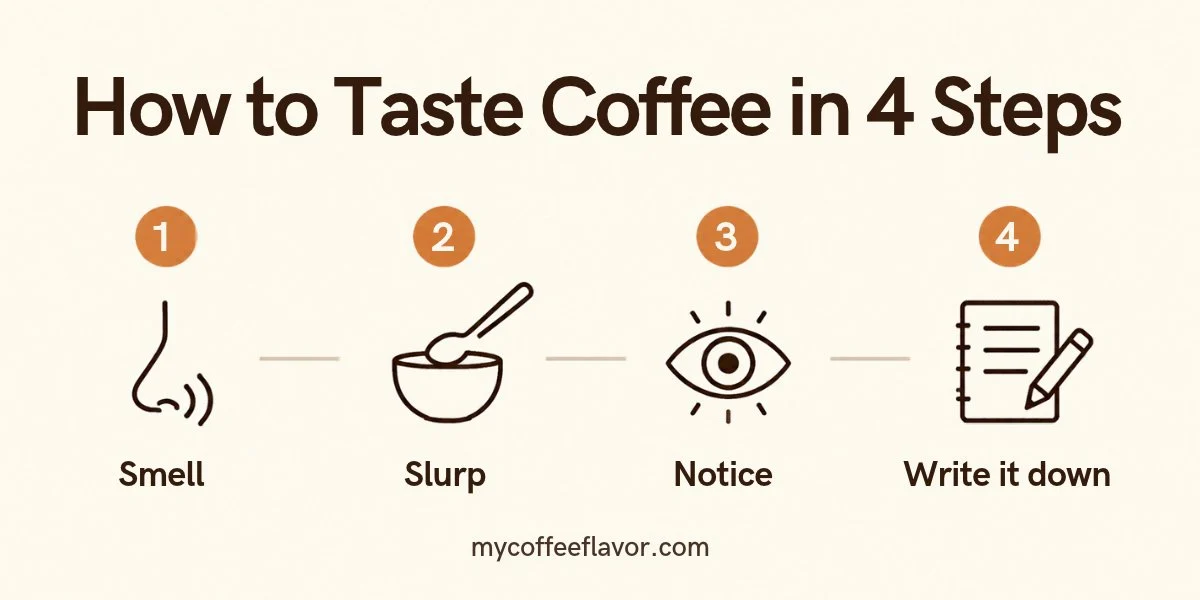
Here is the process:
- Smell the dry grounds
- Smell the wet grounds (bloom)
- Slurp the coffee (yes, slurp)
- Notice where you taste it on your tongue
- Wait for the finish
- Write down what you taste
Do this regularly, and your palate will develop faster than you think.
Why Bother Developing Your Palate?
You might be thinking: Why does it matter? I just want to drink coffee.
Fair enough. But developing your palate has real benefits:
- You will enjoy coffee more. Tasting complexity is more satisfying than drinking “just coffee.”
- You will waste less money. You will know what you actually like, not what marketing tells you to like.
- You will brew better coffee. Understanding flavor helps you adjust grind, ratio, and technique.
- You will have more fun. Coffee becomes a hobby, not just a habit.
What changes: Tasting deliberately turns a routine cup into something worth paying attention to. You start to notice flavors that were always there.
The Coffee Taster’s Vocabulary
Before we start tasting, let’s learn the words.
| Term | What It Means |
|---|---|
| Acidity | Brightness, liveliness, tartness (not the same as sourness) |
| Body | The weight and texture of the coffee on your tongue (light, medium, full) |
| Sweetness | Natural sweetness, not added sugar |
| Bitterness | The harsh, drying sensation (can be pleasant or unpleasant) |
| Finish | The flavors that linger after you swallow |
| Balance | How well all flavors work together |
| Complexity | Multiple distinct flavors that reveal themselves as you drink |
| Clean | No off-flavors or defects |
| Bright | High acidity, lively, sometimes fruity |
| Earthy | Reminds you of soil, mushrooms, or forest floor |
Do not memorize these all at once. Learn them as you taste. The more you taste, the more these words will make sense.
Coffee Tasting — Step-by-Step Procedure
Step 1: Smell the Dry Grounds
Start before you brew.
Take a small amount of ground coffee and place it in a cup. Bring it to your nose and inhale deeply.
What do you smell?
- Chocolate?
- Nuts?
- Fruit?
- Flowers?
- Spices?
- Earth?
Worth knowing: Many people drink coffee for years without ever deliberately smelling the dry grounds. It is one of the easiest places to pick up differences between coffees.
Step 2: Smell the Wet Grounds (The Bloom)
After you pour hot water over the grounds, wait 30 seconds. Then smell again.
The hot water releases aromatic compounds that were locked in the dry grounds. This is called the “bloom,” and it is where many of the most complex aromas appear.
What do you smell now?
- Is it different from the dry grounds?
- Is it stronger?
- Is it sweeter?
- Are there new notes?
Pro tip: Cup your hand over the brewer and smell through the gap between your fingers. This concentrates the aroma.
Step 3: Slurp the Coffee
This is where most people get uncomfortable. Slurping is not rude in coffee tasting. It is necessary.
Why slurp?
- It spreads the coffee across your entire palate
- It aerates the coffee, releasing more aromas
- It helps you taste more
How to slurp:
- Take a small spoonful of coffee
- Bring it to your mouth
- Slurp it in with a sharp intake of breath (like you are eating soup but louder)
- Let the coffee spread across your tongue
Yes, you will feel silly. Do it anyway.
Step 4: Notice Where You Taste It
Your tongue has different taste receptors. Coffee flavors reveal themselves in different areas.
| Area of Tongue | What You Might Taste |
|---|---|
| Tip | Sweetness |
| Sides (front) | Saltiness, sourness |
| Sides (back) | Bitterness |
| Back of tongue | Umami, bitterness |
Tip: Notice how each sensation shows up. Acidity often feels like a mouth-watering brightness, sweetness like a soft, rounded impression, and bitterness like a lingering note at the finish.
Step 5: Wait for the Finish
After you swallow, wait 5-10 seconds. The flavors that linger are called the “finish.”
What do you taste now?
- Is it sweet?
- Is it bitter?
- Does it disappear quickly?
- Does it stay with you?
Why this matters: A good coffee has a pleasant finish. A bad coffee has a harsh, lingering finish. The finish is one of the best indicators of coffee quality.
Step 6: Write It Down
You do not need a fancy tasting journal. A notebook and pen are enough.
Write down:
- The coffee: Origin, roaster, roast date
- The aroma: What you smelled
- The taste: What you tasted
- The body: Light, medium, or heavy
- The finish: What lingered
- Your rating: 1-5 stars
A simple method: Keep a small notebook near your coffee setup. Each time you open a new bag of beans, write down your tasting notes. Looking back over them shows what you like and what you don’t.
The Flavor Wheel: Your Cheat Sheet
Coffee professionals use something called a “flavor wheel.” It organizes coffee flavors into categories.
Here are the main categories:
| Category | Examples |
|---|---|
| Fruity | Berry, citrus, stone fruit, tropical, dried fruit |
| Floral | Jasmine, rose, chamomile, lavender |
| Sweet | Honey, caramel, vanilla, brown sugar, maple |
| Nutty/Cocoa | Almond, hazelnut, chocolate, cocoa |
| Spices | Cinnamon, clove, nutmeg, pepper |
| Roasted | Toast, smoke, char, burnt |
| Green/Vegative | Grass, hay, herbs, bell pepper |
| Other | Earthy, papery, chemical, medicinal |
How to use it: When you taste something, look at the wheel. Does it remind you of fruit? Which fruit? Does it remind you of a spice? Which one? The wheel helps you find the words.
How to Practice (Without Spending a Fortune)
You do not need to buy expensive coffee to develop your palate. You need variety.
Practice Method 1: Compare Two Coffees
Buy two different coffees—different origins, different roasts. Brew them side by side. Taste them back to back.
What is different? What is similar? Which do you prefer?
Try this: Compare an Ethiopian light roast with a Sumatran dark roast. The contrast is large: one is typically bright and fruity, the other earthy and bold, which makes it a good first comparison.
Practice Method 2: Change One Variable
Brew the same coffee three ways:
- One with fine grind
- One with medium grind
- One with coarse grind
Taste all three. Can you taste the difference? Which do you prefer?
Why this works: It teaches you how brewing affects flavor. You will start to understand what “under-extracted” and “over-extracted” actually taste like.
Practice Method 3: The Blind Taste Test
Have someone else brew two different coffees for you. Taste them without knowing which is which.
Can you identify which is which? What flavors do you taste?
Try this: Ask someone to brew two coffees, for example an Ethiopian and a Colombian, without telling you which is which. Then try to tell them apart by the brighter, more floral character typical of Ethiopian coffee.
Practice Method 4: Add Flavors
Taste coffee while eating:
- Dark chocolate
- Almonds
- Dried fruit
- Lemon
Does the coffee taste different? Do the flavors align or clash?
Why this works: It teaches you to identify flavors by comparison. If the coffee tastes more chocolatey when you eat chocolate, you know it has chocolate notes.
Common Mistakes (And How to Avoid Them)
Mistake 1: Tasting Too Many Coffees at Once
Fix: Limit yourself to 2-3 coffees per tasting session. Your palate gets fatigued.
Mistake 2: Tasting on a Full Stomach
Fix: Taste before eating. Food flavors interfere with your ability to taste coffee.
Mistake 3: Using Too Much Coffee
Fix: Use a small amount—about 8-10 grams per cup. You do not need a full mug for tasting.
Mistake 4: Not Rinsing Between Tastings
Fix: Rinse your mouth with water between coffees. Use a plain cracker or piece of bread to cleanse your palate.
Mistake 5: Getting Discouraged
Fix: Palate development takes time. You will not taste “jasmine and bergamot” on your first try. Keep practicing.
How Long It Takes
Developing a palate takes months, not days.
The first few tasting sessions can be frustrating. Everything tastes like coffee. Just coffee.
Then differences start to appear. This coffee is brighter than that one. This one has a sweeter finish. This one tastes nuttier.
With regular practice, tasters learn to recognize broad regional styles, tell a natural process from a washed one, and spot an under-extracted cup.
The secret: Practice. Not special talent. Practice.
The Final Word
You already have a palate. You just need to learn how to use it.
Start with your next cup of coffee. Smell it. Slurp it. Notice the finish. Write down one word that describes what you taste.
Do this every day. In a month, you will be amazed at what you notice.
And the next time you read “notes of jasmine and bergamot” on a bag of beans? You might actually taste them.
Ready to explore more? Check out these related guides:
- The Complete Guide to Coffee Grind Sizes (With Chart)
- Coffee and Chocolate: The Ultimate Pairing Guide
- Why Is My Coffee Bitter? 7 Common Mistakes and How to Fix Them
- The Complete Guide to Coffee Syrups: Vanilla, Caramel, Hazelnut, and More
Frequently Asked Questions
Do I need special equipment to taste coffee?
No. A cup, a spoon, and hot water are enough. A notebook helps, but it is optional.
How long does it take to develop a palate?
A few months of regular practice. Some people notice differences immediately. Others take longer. Both are normal.
What is cupping?
Cupping is the professional method of tasting coffee. It involves brewing coffee in a cup, letting it cool slightly, and slurping it with a spoon. You can cup at home with any coffee.
Why do coffee professionals slurp?
Slurping spreads coffee across the palate and aerates it, releasing more aromas and flavors. It looks silly but works.
What is the best coffee for tasting?
Any coffee you have. You do not need expensive beans. You need variety. Try different origins, roasts, and processing methods.
Can I develop my palate if I only drink instant coffee?
Yes. Instant coffee has flavors too. Try different brands, different origins (if available), and different strengths. You can still practice.
About the Author
Written by RHALMI Mohammed, a coffee enthusiast who has spent ten years brewing at home and trying different methods and gear. Guides on My Coffee Flavor combine that experience with published brewing references, and when a recipe has not been tested yet, the article says so. More about the site.