I’ll be honest with you.
For years, I assumed flavored coffee was a modern invention—something dreamed up by marketing teams in the 1990s to sell more lattes. You know, along with pumpkin spice and unicorn frappuccinos.
Turns out, I couldn’t have been more wrong.
The real story of flavoring coffee stretches back centuries, long before anyone bottled the first syrup. It begins in the Middle East, where coffee itself was born, and where people first discovered that spices and coffee belong together.
Need a glimpse of the history of coffee syrup? let’s get started!
Table of Contents
Part One: The Ancient Roots of Flavored Coffee (Middle East & North Africa)
Where It All Began
Long before Europeans ever tasted coffee, the people of the Middle East were already experimenting with ways to enhance it . The earliest versions of flavored coffee date back centuries, with cultures across the Arab world adding spices directly to their coffee grounds during brewing—a tradition that continues today in places like Saudi Arabia, Yemen, Turkey, and Morocco.
The first coffee drinkers didn’t drink it black. They drank it spiced.
Yemen: The Birthplace of Coffee and Spice Blends
Yemen, which was once the world’s only source of coffee, developed one of the earliest known coffee spice mixtures called hawaij al-gahwa . This traditional blend includes ginger, cloves, and bishop’s weed (a slightly acrid spice that tastes like thyme mixed with cumin) . Yemeni coffee, particularly the famous coffee from the port of Mokha, is known for its naturally complex flavor profile—chocolate, nuts, and a distinct spiciness that made adding complementary spices a natural instinct .
According to historical records, Arab scholars in the 15th century described coffee mixed with milk, sugar, and even oud (agarwood)—a fragrant resin used in perfumes. This challenges the common assumption that adding flavors to coffee started in Europe. It didn’t. It started in the Middle East.
Morocco: The Spice Kingdom’s Coffee Tradition
Morocco offers one of the most beautiful examples of the spiced coffee tradition. Here, coffee isn’t just a drink—it’s a ritual, and it’s typically reserved for the home rather than cafés.
The Moroccan spiced coffee beverage is called Qahwa Ma’atra (or sometimes Qahwa Maachba in southern regions), and it contains upwards of five or more spices. This aromatic brew is traditionally prepared by the female head of the household and poured for guests, with several rounds of drinking being common.
What goes into Moroccan spiced coffee? The spice blend varies by family tradition, but typically includes :
- Cinnamon (qarfa) – Balances blood sugar and adds warmth
- Cloves (qrunfil) – Antiseptic properties, warms the body
- Cardamom – The quintessential Arabic coffee spice
- Nutmeg – Sweet, aromatic notes
- Ginger (skinjbir) – Stimulates circulation, eases nausea
- Black pepper – For a more pungent, savory cup
- Anise (nafaâ) – Aids digestion
- Lavender (khzama) – Calms the nervous system (common in southern Morocco)
In southern Morocco and Saharan regions, the tradition runs even deeper. Herbal coffee known as Qahwa Maachba blends coffee with medicinal herbs like sage, fennel, and wormwood, valued not only for flavor but for their healing properties—a true “wellness drink” centuries before the term existed.
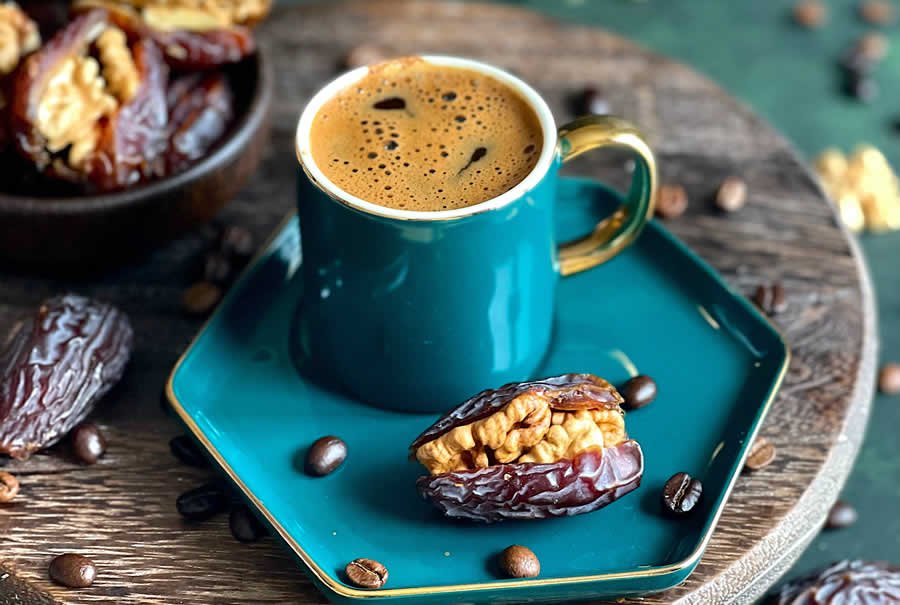
The preparation itself is ceremonial. Spices are often bought whole and ground fresh for each batch. Some families grind the spices together with the beans, though purists grind them separately to avoid lingering aromas on their coffee grinders. The coffee is brewed in a pot with water, spices, and sugar, then served in small cups—often accompanied by dates, which provide natural sweetness alongside the complex, spicy brew.
The Arabian Peninsula: Cardamom Rules
Across the Arabian Peninsula and the Syrian desert, cardamom is the essential coffee spice. For Bedouins, adding cardamom to coffee is practically a cultural identifier—pop songs aiming for a nomadic note include lines like “Make some coffee and don’t spare the cardamom“.
Arabic coffee (qahwah arabiyya) is typically made with lightly roasted beans and spiced with cardamom, sometimes joined by saffron, cloves, or cinnamon. It’s served in small cups called finjān, usually without sugar, and always accompanied by dates or dried fruit. The coffee is boiled, unfiltered, and intensely aromatic—a far cry from the mild, filtered coffee many Westerners know.
Why Milk Never Caught On (A Fascinating Historical Note)
Here’s something I found surprising: Middle Eastern coffee traditions historically avoided milk. Arabic coffee has been made without milk for centuries, and early European travelers found this puzzling.
The reason?
Middle Eastern coffee traditions historically avoided milk to preserve the purity, aroma, and potent flavor of the coffee, which was traditionally viewed as a stimulating, dark brew rather than a creamy beverage. This practice originated from the Sufi mystics’ use of coffee as a spiritual aid and its subsequent role as a social drink in the Ottoman Empire.
Part Two: Two Paths to Coffee Syrup
While the Middle East was perfecting the art of brewing whole spices with coffee, two separate inventions were emerging elsewhere that would shape how we flavor coffee today.
The Scottish Soldier’s Coffee (Camp Coffee)
Our story now moves to 1876 in Glasgow, Scotland.
A company called R. Paterson & Sons introduced a product that would become legendary: Camp Coffee. It was a concentrated syrup made from coffee, chicory, water, and sugar—essentially, the world’s first mass-market instant coffee.
According to company lore, the syrup was developed specifically for the Gordon Highlanders, a Scottish military regiment serving abroad. Soldiers couldn’t exactly set up pour-over stations on the battlefield. They needed caffeine, and they needed it fast.
The solution? A bottle of syrup they could splash into hot water or milk and drink immediately.
For much of the 20th century, Camp Coffee occupied an odd place in British kitchens. As one writer describes it:
“For people who grew up in working-class families in the United Kingdom during the 1950s and ’60s, it is nostalgia in a bottle. The coffee habit had hardly touched such communities at that time and tea was the almost-universal choice for a hot drink. The bottle of Camp often sat on the shelf for years, just in case the dreaded coffee-drinking relative turned up unexpectedly.”
By the 1970s, freeze-dried instant coffee had largely replaced Camp Coffee as a daily beverage. But the syrup didn’t disappear. It simply moved to the baking aisle, where it remains popular today for adding coffee flavor to cakes, cookies, ice cream, and even Rice Krispie treats.
Part Three: The Rhode Island Story (Coffee Syrup and Rhode Island Coffee Milk)
Now let’s cross the Atlantic to America, where a completely separate coffee syrup tradition was taking shape.
The Italian Immigration Connection
In the late 19th and early 20th centuries, approximately 55,000 Italian immigrants made their way to Providence, Rhode Island. They became the largest immigrant group in the state, and they brought their culinary traditions with them—including their relationship with coffee.
Here’s some history:
“The vibrant trade between the Republic of Venice and the people of North Africa, Egypt, and the East brought a large variety of African goods, including coffee, to this leading European port. Venetian merchants introduced coffee-drinking to the wealthy in Venice, charging them heavily for the beverage”
Italian families had a tradition of drinking sweetened coffee with milk, often letting children have a small amount. This custom, combined with the ingredients available in their new home, would spark something entirely new.
The Accidental Invention
No one knows exactly who made the first coffee syrup. But the most widely accepted story points to a soda fountain operator sometime in the early 20th century.
Picture the scene: A fountain worker had leftover coffee grounds at the end of the day. Instead of throwing them out, he experimented—perhaps sweetening them with sugar, adding water, and straining the mixture. What emerged was a thick, sweet, intensely coffee-flavored syrup.
He stirred it into milk and discovered something wonderful. Coffee milk was born.
From Soda Fountains to Store Shelves
The idea caught on quickly. By the 1930s, coffee milk was regularly served at pharmacy lunch counters throughout Rhode Island and southeastern Massachusetts. And here’s a detail I love: it was specifically marketed to children and young people as an alternative to the hot coffee their parents drank.
Think about that. In an era when we agonize over giving kids caffeine, soda fountains were actively promoting coffee-flavored milk to the younger set. Different times.
The First Bottled Syrups
As demand grew, entrepreneurs saw an opportunity to bottle this magic.
The first documented coffee syrup for retail sale came from D. Abelsen & Son, who created “Arabian Brand Coffee Syrup” in Grant Mills, Cumberland, Rhode Island. An advertisement appeared in the 1926 Ice Cream Trade Journal, promoting it for “Ice Cream Topping, Milk Shakes, Iced Coffee, Etc.”
Silmo Packing Company of New Bedford, Massachusetts began mass-producing coffee syrup in 1932. Then in 1938, Warwick, Rhode Island’s Eclipse Foods launched its own version. And in the 1940s, a company called Autocrat Coffee entered the market from Lincoln, Rhode Island.
These brands would compete for decades until Autocrat acquired Eclipse in 1991. Today, Autocrat produces both brands and remains the dominant name in coffee syrup.
Official State Recognition
Here’s where the story gets wonderfully quirky.
In 1993, the Rhode Island Legislature decided to choose an official state drink. The two finalists were coffee milk and Del’s Lemonade—another Rhode Island institution.
Coffee milk won.
On July 29, 1993, Rhode Island officially named coffee milk its state drink. It remains the only US state with a coffee-based official beverage.
As one writer put it: “A Swallow Will Tell You.”
What’s the Difference?
By now, you might be wondering: Are these all the same thing?
No, and understanding the differences helps us appreciate each tradition.
| Tradition | Method | Key Flavors | Cultural Context |
|---|---|---|---|
| Middle Eastern Spiced Coffee | Whole spices brewed with grounds | Cardamom, cinnamon, cloves, ginger, saffron | Hospitality ritual, family tradition |
| Moroccan Qahwa Ma’atra | Multi-spice blend brewed with coffee | Cinnamon, ginger, pepper, anise, lavender | Home-based, medicinal, ceremonial |
| Camp Coffee (Scottish) | Bottled syrup (chicory + coffee) | Coffee, chicory, sugar | Military convenience, baking ingredient |
| Rhode Island Coffee Syrup | Sweetened coffee concentrate | Pure coffee + sugar | Soda fountain culture, state drink |
The Middle Eastern tradition is the oldest—centuries old—and it treats spicing as an integral part of the brewing process, not an addition afterward. The syrup traditions are younger, born of convenience and commerce, but they carry their own cultural weight.
The Modern Revival
In recent years, there’s been a beautiful convergence. A new generation of coffee lovers has rediscovered what the Middle East knew all along: spices and coffee belong together.
Artisan syrup makers like Dave’s Coffee and Morning Glory now offer versions with no high-fructose corn syrup and no artificial colors—appealing to modern tastes while honoring the Rhode Island tradition. Meanwhile, coffee shops worldwide have embraced spiced lattes, from chai-infused creations to Moroccan-inspired blends.
And in Morocco, the tradition continues in homes, where Qahwa Ma’atra is still prepared with care, passed down through generations, and shared with guests as a gesture of warmth and hospitality .
Why This History Matters for Home Brewers
I share all of this because I think context makes everything taste better.
When you stir homemade vanilla syrup into your morning latte, you’re participating in a tradition that spans continents and millennia. You’re connected to:
- Yemeni traders who first carried coffee beans across the Red Sea
- Moroccan households where grandmothers still blend cinnamon and ginger by instinct
- Bedouin hosts who judge their coffee by the quality of its cardamom
- Italian immigrants preserving their coffee culture in a new land
- Scottish soldiers craving caffeine on the battlefield
- Rhode Island soda fountain operators turning leftovers into a state treasure
And here’s the practical takeaway: flavoring coffee isn’t complicated or new. It’s as old as coffee itself. Whether you’re grinding cardamom into your Turkish coffee, stirring homemade vanilla syrup into your latte, or experimenting with cinnamon in your French press, you’re continuing a tradition that humans have enjoyed for centuries.
Make Your Own Connection
If you want to taste this history yourself, here are a few ways:
- Try Moroccan-style spiced coffee: Brew your coffee with cinnamon, ginger, cloves, and a pinch of black pepper. Serve with dates.
- Make Arabic coffee: Lightly roast coffee beans, grind with cardamom, and boil in a pot. Serve in small cups without sugar.
- Order authentic Rhode Island syrup from Autocrat or Dave’s Coffee online.
- Try Camp Coffee if you’re curious about the British version (look in the baking aisle).
- Make your own syrup using the traditional method: simmer strong coffee with equal parts sugar until slightly thickened.
Then raise your cup—whether it’s a tiny finjān of spiced Arabic coffee or a tall glass of coffee milk—and honor the generations of coffee lovers who came before us.
Ready to explore further?
- How to Make Moroccan Spiced Coffee at Home
- The Complete Guide to Coffee Syrups: Vanilla, Caramel, Hazelnut, and More
- 15 Cheap Coffee Hacks That Taste Expensive
FAQ about the History of Coffee Syrup
What is coffee syrup?
Coffee syrup is a sweetened coffee concentrate made by straining water and sugar through coffee grounds. Think of it as the coffee equivalent of chocolate syrup—it’s thick, sweet, and intensely flavored. The traditional preparation involves brewing strong coffee, then cooking it down with sugar until it reaches a syrupy consistency.
Coffee syrup serves as the key ingredient in coffee milk (Rhode Island’s official state drink), which is made by stirring the syrup into milk just like chocolate milk. It’s also used in milkshakes (called “cabinets” in Rhode Island), as an ice cream topping, and in baking.
Manufacturing methods vary. Some producers use a hot process—straining hot water and sugar through coffee grounds—while others use a cold-process method that involves soaking pulverized coffee beans for an extended period before adding sugar.
Is coffee syrup a Rhode Island thing?
Yes, strongly. While you can find coffee syrup elsewhere, it’s deeply woven into Rhode Island’s cultural identity .
Coffee syrup emerged from the state’s large Italian immigrant population in the late 19th and early 20th centuries. Approximately 55,000 Italian immigrants settled in Providence, bringing their tradition of drinking sweetened coffee with milk. Soda fountain operators eventually began bottling the syrup, and by the 1930s, coffee milk was being served to children at pharmacy lunch counters throughout the state.
In 1993, coffee milk—made with coffee syrup—became the official state drink of Rhode Island, beating out Del’s Lemonade in a legislative competition. It remains the only US state with a coffee-based official beverage.
Today, brands like Autocrat (founded in the 1940s and now the dominant producer) and newer artisans like Dave’s Coffee continue the tradition. You’ll find coffee syrup in Rhode Island supermarkets, diners, and even in local creations like coffee milk stout from Narragansett Brewing Company.
Where did Torani syrup originate?
Torani syrup originated in San Francisco’s North Beach neighborhood in 1925.
Italian immigrants Rinaldo and Ezilda Torre brought syrup recipes from their hometown of Lucca, Italy, to California. They began crafting syrups in their Italian wholesale grocery, introducing flavors like Grenadine, Lemon, Orgeat, Anisette, and Tamarindo.
The Torres introduced a uniquely American creation to local cafes: the Italian soda—their syrups mixed with sparkling water. After Prohibition ended in the 1930s, Ezilda Torre led the company through the Great Depression and WWII as one of the first female spirit rectifiers in the United States.
Torani’s original Vanilla Syrup later created what’s considered the world’s first flavored latte, cementing the brand’s place in coffeehouse culture.
Today, the company remains family-owned (run by the Torres’ grandchildren) and produces over 100 syrup flavors from facilities in the San Francisco Bay Area .
Is Monin syrup French?
Yes, Monin is authentically French.
The company was founded in 1912 by Georges MONIN in the small town of Bourges, France. Georges, described as “a man passionate about flavours,” created fruit-based syrups to enhance beverages and desserts, giving birth to “Le sirop de MONIN” .
The company remains deeply connected to its French roots. While MONIN now operates in over 150 countries with production centers on every continent, its headquarters and a manufacturing plant remain in Bourges. The company opened “La Villa MONIN” in Bourges in 2022 and “Le Comptoir MONIN” in Paris in 2025, celebrating over a century of French craftsmanship.
Like Torani, MONIN evolved from a family business into a global leader in flavored syrups, with the founder’s passion for quality passed down through generations .
Is coffee originally Arabic?
The word “coffee” has Arabic origins, but the plant itself is African.
The English word “coffee” comes via Dutch koffie from Turkish kahveh, which derives from the Arabic qahwah. Arab etymologists connected qahwah with a word meaning “wine,” reflecting coffee’s role as an early social beverage.
However, the coffee plant likely originated in the Kaffa region of Ethiopia. (Interestingly, coffee in the Kaffa language is called būno, which was borrowed into Arabic as bunn for “raw coffee.”)
Coffee cultivation and drinking as a social practice first developed in the Arabian Peninsula. The first coffee-houses appeared in Mecca in the 1510s. The beverage reached Turkey by the 1530s and Europe around 1515-1519, arriving in England by 1650 .
So while the plant is Ethiopian, the word and the culture of coffee drinking as we know it today emerged from the Arab world.
Why was coffee known as Satan’s drink?
Coffee earned the nickname “Satan’s drink” when it first arrived in Western society due to its association with the Islamic world.
When coffee began spreading beyond the Middle East, some Europeans viewed it with suspicion and prejudice. Its origins in Muslim cultures led to it being commonly dubbed “Satan’s Drink”.
According to popular legend, this changed thanks to Pope Clement VIII in the late 16th or early 17th century. When members of his court urged him to denounce coffee, the pontiff insisted on trying it first. After a few sips, he reportedly announced:
“This Satan’s drink is so delicious that it would be a pity to let the infidels have exclusive use of it.”
Tradition holds that Pope Clement then “baptized” coffee beans to cleanse them of devilish associations—whether metaphorically or through an actual exorcism rite, historians aren’t certain. Once Catholics knew coffee was permitted, it spread through Europe rapidly, eventually reaching Protestant communities and transforming Western society. Coffee houses became centers of intellectual exchange during the Age of Enlightenment.
What is the 80/20 rule for coffee?
The 80/20 rule (or Pareto Principle) applied to coffee is a simple method for finding a coffee’s optimal extraction “sweet spot” with minimal effort.
The Pareto Principle states that roughly 80% of results come from 20% of causes. In coffee, this means focusing on the most important variable: extraction.
Here’s how the 80/20 method works :
– Under-extracted coffee tastes sour and empty
– Over-extracted coffee tastes dry and bitter
– As you move from under to over, coffee gets progressively sweeter until it suddenly becomes bitter
The goal is to extract coffee just before that bitter dryness appears—the sweetest possible point .
How to apply it:
1. Keep the same weight of coffee grounds throughout
2. To extract more: Grind finer AND/OR brew longer AND/OR use more water
3. To extract less: Grind coarser AND/OR brew shorter AND/OR use less water
By ignoring all other variables (temperature, agitation, water chemistry) and focusing solely on extraction, you can quickly find the best possible flavor from any coffee and brewing method . As Barista Hustle explains, finding this sweet spot gets you “close to (or at least approaching) 80% of a coffee’s potential” .
About the Author
Written by RHALMI Mohammed — ten years of hands-on coffee obsession, testing brewing methods, comparing gear, and chasing the perfect cup at home. Every recipe, comparison, and guide on My Coffee Flavor comes from actual brewing, not just research.